
How to Sell Tickets for a Club Night in Los Angeles: The 2026 Playbook
By Event Visionary · Updated · 6 min read

Selling out a club night in Los Angeles isn't about one big Instagram post. It's a sequence: a budget that tells you how many tickets you need to sell, a price ladder that rewards people for buying early, promoters you can track, texts that land at the right moment, and a door that moves fast.
This guide walks you through how to sell tickets for a club event in LA, from the first number on your spreadsheet to the morning-after export. It includes the California pricing rules every LA organizer should know as of October 2026.
Step 1: Know your numbers before you announce
Before you design a flyer, write down what the night costs and how many tickets cover it. Your list usually includes the venue fee or bar minimum, DJs and hosts, security, production (sound, lights, visuals), photography, and marketing spend.
Divide your total cost by your average ticket price to get your break-even ticket count. If the night costs $4,000 and your average ticket is $25, you need 160 tickets to break even. Anything after that is profit, or room to upgrade the lineup next time.
Step 2: Build a ticket price ladder
Tiered pricing gives people a reason to buy now rather than "see how I feel Saturday." A simple ladder for a 300-capacity room might look like this:
| Tier | Quantity | Price | When it opens |
|---|---|---|---|
| Early bird | 75 | $15 | Announcement day |
| Tier 1 | 100 | $20 | When early bird sells out |
| Tier 2 | 75 | $25 | About 10 days out |
| Final release | 50 | $30 | Week of the event |
| Door | Remaining | $35 | On the night, if capacity allows |
Keep the jumps small enough that people don't feel punished, and big enough that "price goes up Friday" is a real reason to buy. Add a VIP or table option if your venue has the space. Higher-priced tickets often carry much of your margin.
Step 3: Show all-in prices (California and FTC rules)
This step trips up a lot of LA organizers. Since July 1, 2024, California's Honest Pricing Law (SB 478) has required the price you advertise to include all mandatory fees and charges, except government taxes and reasonable shipping. The California Attorney General's guidance lists event tickets explicitly. Revealing fees later at checkout doesn't satisfy the law.
At the federal level, the FTC's Rule on Unfair or Deceptive Fees has applied to live-event tickets since May 12, 2025. It requires businesses that advertise a ticket price to show the total price upfront, including mandatory fees, more prominently than other pricing information.
- On flyers, captions and texts, quote the price buyers will actually pay, not the face value before fees.
- If a $25 ticket carries a $3.50 fee, advertise it as $28.50.
- Use the checkout total your ticketing platform shows as the number in your marketing.
This isn't legal advice. Read the California AG's hidden fees guidance and the FTC's FAQ, and talk to a lawyer if you're unsure how they apply to you.
Step 4: Pick a ticketing platform that fits nightlife
For club nights, the features that matter most are fees, payout speed, team roles for promoters and box office, a way to reach past buyers, and fast check-in. Ask each platform:
- Who pays the platform fee, and can I keep my full ticket price?
- When does ticket money reach my bank? Daily, or after the event?
- Can I add promoters and box office staff without giving them access to everything?
- Can I text people who bought tickets before?
- Does it handle talent payments, or do I need another app for my DJs?
Event Visionary is LA-based ticketing built for nightlife. Organizers pay zero platform fees (the $1 + 10% per-ticket fee is paid by the buyer), payouts are daily by default, and you can text your whole guest list from the dashboard. Compare it with the alternatives in Posh vs Eventbrite vs Event Visionary and our list of the best free ticketing platforms.
Step 5: Set up promoters and your team
LA nightlife still runs on promoters. To make it work without confusion:
- Agree on terms in writing. Commission per ticket or a flat fee, when it's paid, and what counts as their sale.
- Give every promoter their own way to be tracked, such as a unique link or code, so sales are attributed properly.
- Limit access. Promoters should see their own sales, not your payouts. On Event Visionary you can add multiple org members with roles, like box office and promoters.
- Share a weekly scoreboard. A quick sales update keeps promoters pushing all the way to the night.
Step 6: Promote the night, and text your list
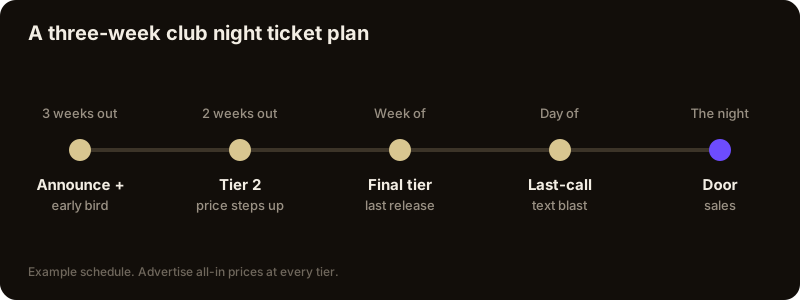
Social posts build awareness. Text messages tend to close the sale. A simple three-week club night promotion plan:
| When | Channel | What to send |
|---|---|---|
| 3 weeks out | Instagram, TikTok, text to past guests | Announcement, lineup, early-bird link |
| 2 weeks out | Stories, promoter pushes | Early bird is gone, Tier 1 is live |
| 10 days out | Text to past guests | Price goes up soon; set times or a guest DJ reveal |
| Week of | Stories, DJ reposts, group chats | Final release, all-in price |
| Day of | Text to buyers and past guests | Doors, address, dress code, last tickets |
Your best buyers are the people who came last time. With Event Visionary you can text your whole guest list from the dashboard and run SMS campaigns to build a phone list for the next event. Only text people who have agreed to hear from you, and always include a way to opt out.
Step 7: Book and pay your DJs without the drama
Payment disputes with talent are one of the fastest ways to burn a relationship in a small scene. Use a clear agreement with the set time, set length, fee, deposit and cancellation terms.
On Event Visionary you can hire DJs and other talent and pay them escrow-style. You deposit the fee, and it's released when the gig is confirmed complete, with dispute resolution if something goes wrong. Talent onboards once, so you're not collecting a new W-9 every booking.
Step 8: Run a fast, friendly door
- Test the scanner before doors. Scan a test ticket on every device you'll use.
- Separate lines. One for pre-sold tickets, one for guest list and door sales, so your fastest guests aren't stuck behind questions.
- Give box office staff their own access. They need to sell and check in, not see payouts.
- Post the door price clearly, as an all-in price, to avoid arguments at the rope.
- Have a capacity plan. Know when to stop door sales so you stay within your venue's limits.
Step 9: After the night, get paid and plan the next one
Your next event starts the morning after this one. Check your payouts (daily by default on Event Visionary, with instant payouts via Stripe once you're eligible), settle with promoters using their tracked sales, and pay talent.
Export your attendee and order lists to CSV and look at which tier sold fastest, which promoter drove the most sales, and how many people bought at the door. Then text a thank-you with the date of your next night while the memory is fresh.
Sell your next LA club night on Event Visionary
List free, pay zero platform fees as an organizer, text your guest list, and get paid daily.
Create your free accountFrequently asked questions
How do I sell tickets for a club event?
Work out your break-even, set a tiered price ladder, choose a ticketing platform, add trackable links for promoters, promote on social, text past guests, and run a fast door with tested scanners.
Do I have to include fees in my ticket price in California?
Since July 1, 2024, California's Honest Pricing Law has required advertised prices to include all mandatory fees except government taxes and shipping, and the Attorney General's guidance names event tickets. The FTC's fee rule has also required total-price disclosure for live-event tickets since May 12, 2025. This isn't legal advice.
When should I start selling tickets for a club night?
Many organizers announce about three weeks out with an early-bird tier, then raise prices in steps as the date gets closer. Larger events with headliners often announce earlier.
What's the best ticketing platform for club nights in LA?
Look for low organizer fees, fast payouts, team roles for promoters and box office, and a way to text past buyers. Event Visionary is LA-based, built for nightlife, and charges organizers zero platform fees.
Sources
Competitor fees and features were checked on each platform's official pages on October 26, 2026. Pricing changes often, so confirm current rates before you decide.